Opportunities for possible pilot/follow-up actions
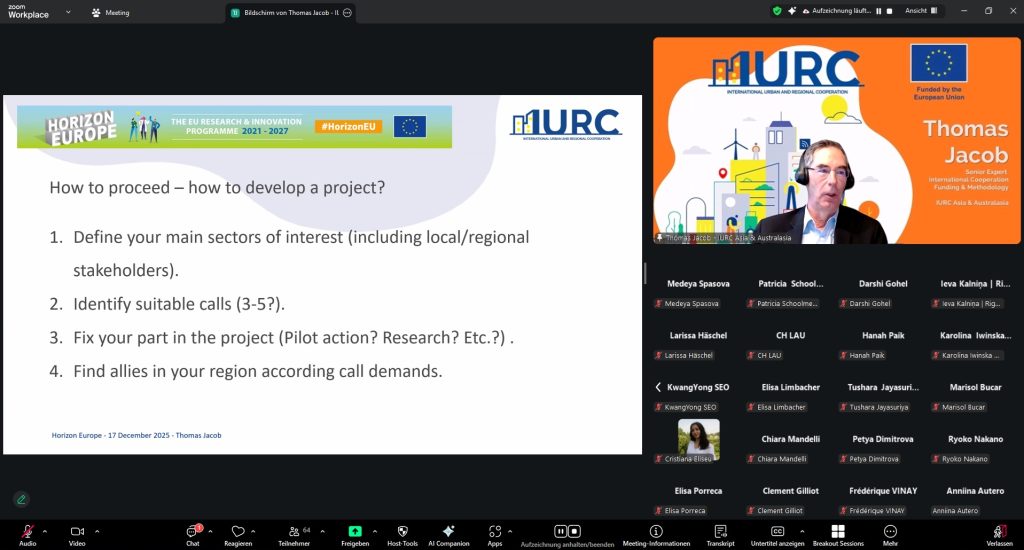
On 17 December 2025, the International Urban and Regional Cooperation – Asia & Australasia (IURC-AA) programme hosted a follow-up training webinar on Horizon Europe, building on the discussions initiated during the October 2025 IURC webinar on EU research and innovation opportunities.
The session, led by Thomas Jacob, Senior Advisor for Funding and Methodology at International Urban and Regional Cooperation (IURC-AA), brought together 65 participants from partner regions and cities, as well as IURC project managers, to deepen understanding of how Horizon Europe can support concrete international cooperation projects.
Deepening engagement with Horizon Europe
Participants received a comprehensive overview of Horizon Europe, the EU’s €95.5 billion research and innovation framework programme for 2021–2027. The presentation explained the programme’s structure, with particular focus on Pillar II – Global Challenges and European Industrial Competitiveness, and its thematic clusters, including climate, mobility, health and digital transformation.
The webinar highlighted how IURC cities and regions can integrate Horizon Europe into their long-term development strategies, moving beyond networking towards structured project cooperation. Guidance was provided on identifying relevant calls, building strong international consortia, and preparing competitive proposals for the 2026–2027 work programme cycle.
International cooperation in practice
A key message of the session was that Horizon Europe offers significant opportunities not only for EU partners, but also for organisations from Associated Countries, such as New Zealand and the Republic of Korea, and -from January 2026 onwards- Japan.
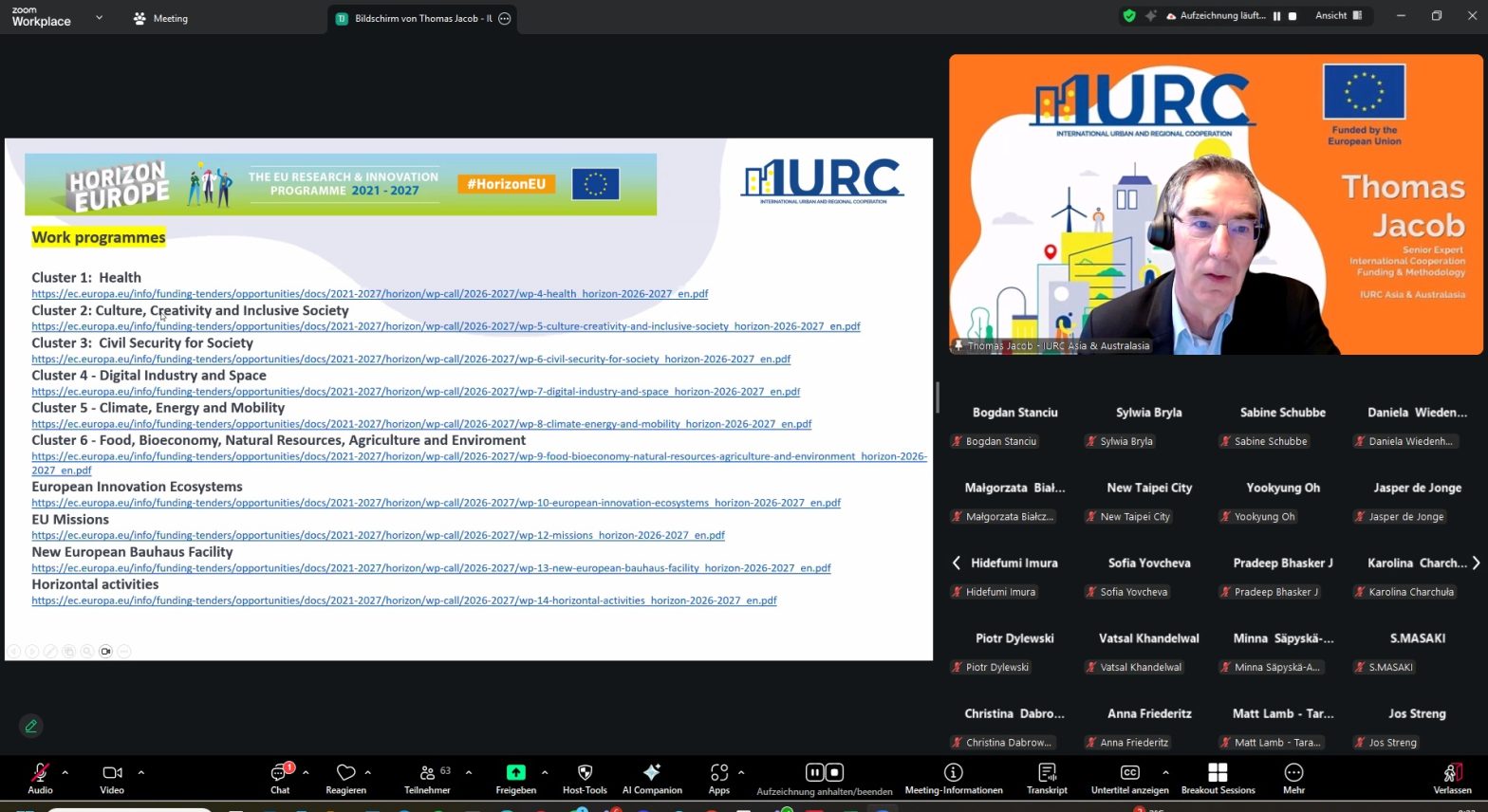
Current calls for proposals (as of December 2025) with content relevant to the regions and cities represented in the IURC programme were shown, in line with the time required for project development with deadlines in autumn 2026. Links to the current work programmes were provided, along with instructions on how to work effectively with them to identify suitable calls for IURC partners from the large number of calls for proposals.
It was explicitly pointed out that it would be highly beneficial to the needs of the IURC partners, as expressed in previous cluster communications, to go beyond the classic IURC mechanisms and establish specific and concrete international working relationships within the framework of concrete project cooperation. For existing project development activities in the Horizon programme of European bodies, the involvement of non-European partners could represent significant added value, as they have valuable experience and developments to offer EU partners.
Interactive exchange and next steps
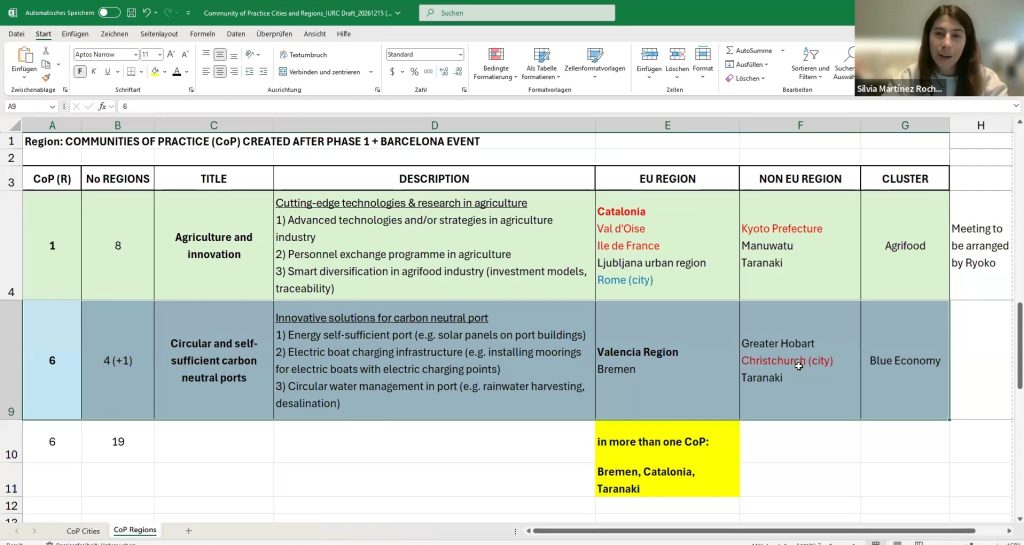
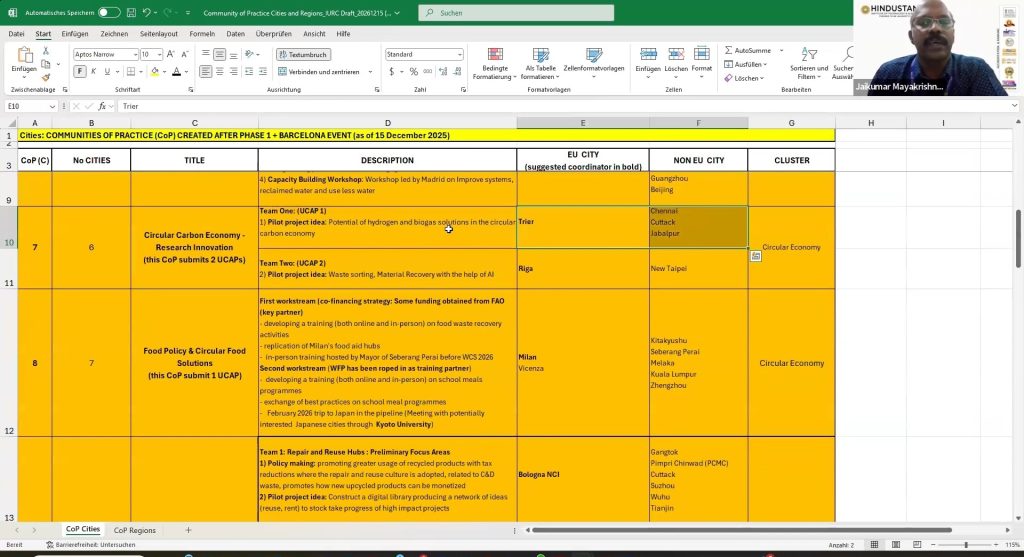
The webinar concluded with a discussion about the creation of allocation of EU regions and cities to the Communities of Practice (CoPs). Representatives from the Ljubljana Urban Region, the Valencia Region and Chennai explained their thematic priorities and the steps undertaken to identify suitable partners in the IURC community.