
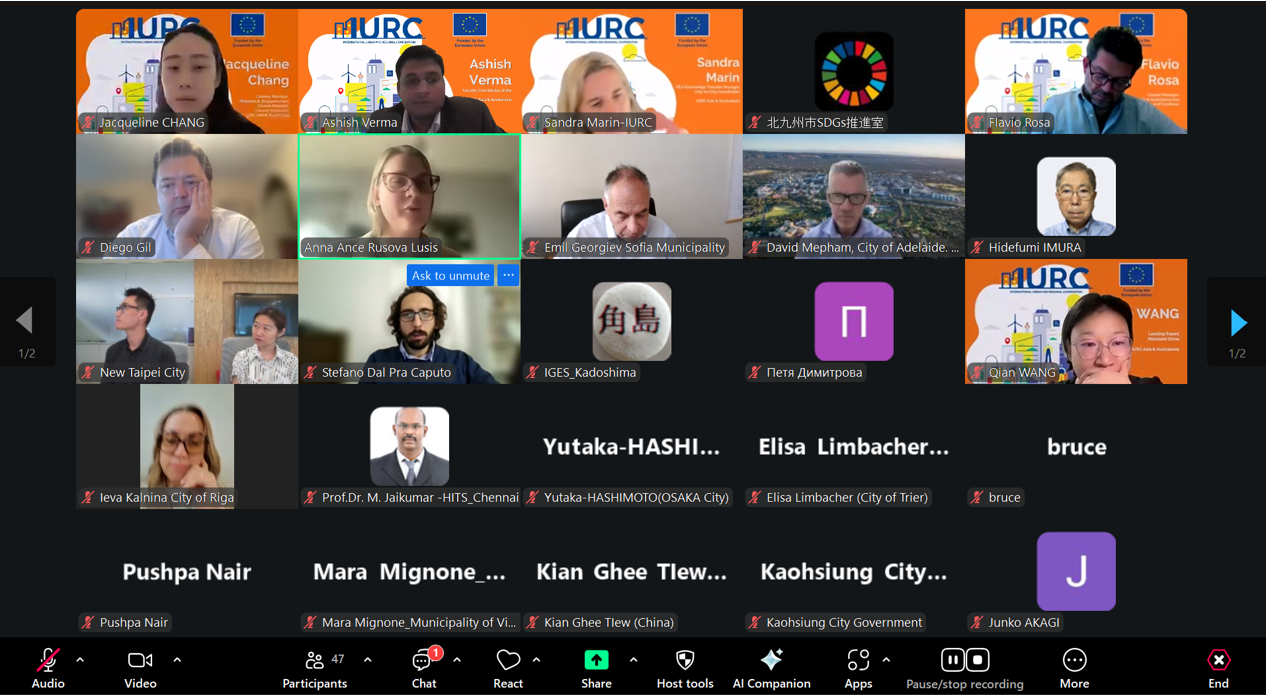
The final webinar on Circular and Regenerative Business Models marked the conclusion of the IURC Asia & Australasia deep dive webinar series and brought together 46 participants for an online exchange featuring presentations from five cities across Europe and Asia . The session focused on practical approaches to circular and regenerative business models, with contributions highlighting policy frameworks, technological solutions, and governance models that support sustainable urban transitions.
Across the presentations and discussions, participants explored the role of data management, community engagement, and international cooperation in advancing circularity. The session placed particular emphasis on moving beyond linear systems towards regenerative models that integrate sustainability, inclusion, and innovation.
Granada’s Smart Circularity – AI tools and Centre
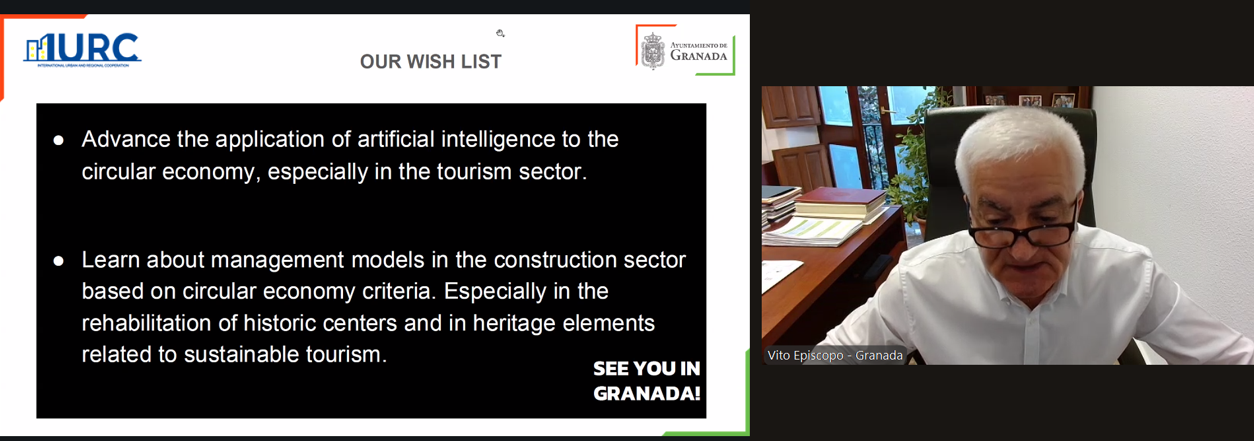
Mr. Vito Episcopo, Deputy Mayor of Granada, Spain, presented the city’s circular economy action plan, outlining key environmental challenges related to air quality, waste management, and water management. He highlighted several successful practices, including the development of a bio-factory approach to water treatment, an urban AI demonstration centre, and the implementation of a Pay-As-You-Throw waste management system .
Mr. Episcopo further explained Granada’s open urban data platform and circular resources map, which are accessible to organisations and citizens. He described how predictive waste analysis is conducted using population density data, Geographic Information Systems (GIS), and statistical models to analyse historical waste generation. These tools support optimised collection routes, improved container placement, and a better understanding of changes in waste composition and volume, including impacts observed during the COVID-19 pandemic across the wider Granada area.
Riga’s Circular Economy Action Plans and Flagship Urban Resource Centres
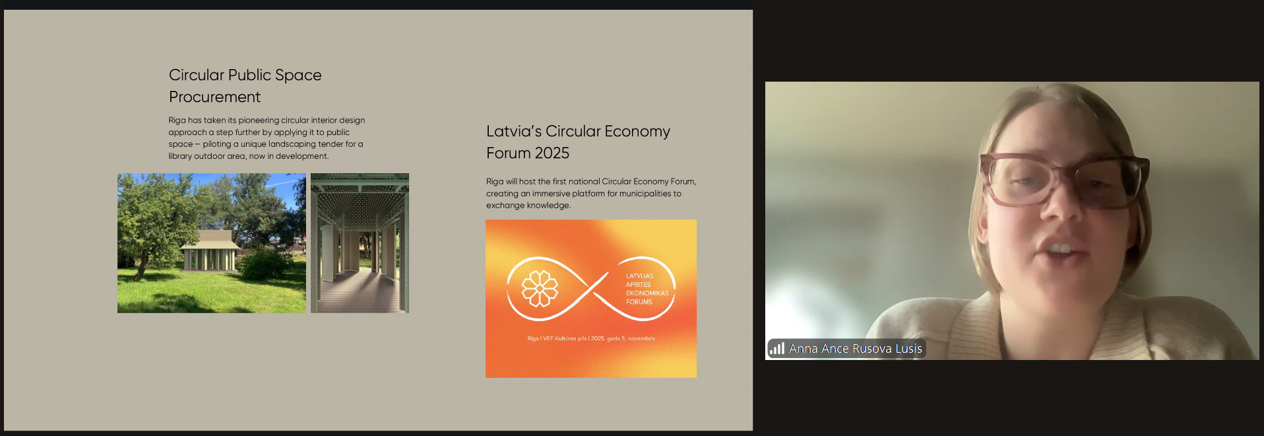
Ms. Anna Ance Rusova Lūse, Circular Economy Expert at Riga City Municipality Agency “Riga Energy Agency,” presented Riga’s Road to Climate Neutrality – Smart City strategy and outlined the city’s Circular Economy Action Plan 2026–2030, which includes 36 key activities . She highlighted Riga’s flagship urban resource centres as key best practices, noting that these centres have supported replication efforts in other European cities.
Ms. Rusova Lūse also presented Riga’s work on circular public procurement, including a pioneering approach to circular interior design and a pilot landscaping tender for a library outdoor area currently under development. Looking ahead, Riga identified priorities such as expanding its urban resource centres, developing circular procurement templates, sharing knowledge through Barcelona-based platforms with Asia–Australasia cities, and testing new approaches to citizen engagement.
During the interactive discussion, Ms. Qian Wang, Country Coordinator for Mainland China under IURC Asia & Australasia, enquired about potential collaboration with Chinese cities on education programmes. Ms. Rusova Lūse expressed interest in engaging youth audiences and exploring cooperation with Chinese partners. Professor Dr. M. Jaikumar raised questions on how Riga ensures sustained participation and collaboration through its urban research centres and replication models.
Kitakyushu’s Green Transformation Journey
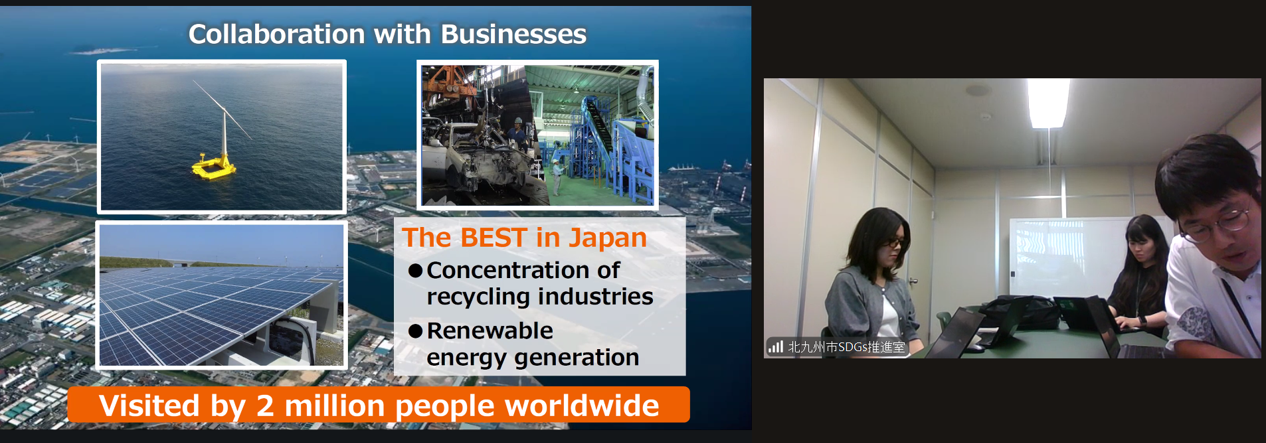
Representatives from Kitakyushu City, Japan, presented the city’s transformation from one of the most polluted cities in the 1960s to a global leader in environmental technologies, circular economy solutions, and water infrastructure development . Ms. HANADA Momoyo and Mr. NAKASHIMA Tatsunori from the International Policy Division highlighted Kitakyushu’s position as a leading circular economy hub, hosting the largest concentration of recycling companies in Japan.
The presentation showcased flagship initiatives such as the Ecotown project, which has established Kitakyushu as a national centre for recycling and renewable energy. Current projects include studies and initiatives on solar panel recycling and advanced waste management systems. The city also emphasised international cooperation, including an agreement with Telangana, India, to develop an Indian ecotown. Total investments in the Ecotown projects were reported to have reached approximately 520 million euros, underlining the scale of Kitakyushu’s long-term commitment to circular development.
Sofia’s Smart Waste Management Strategy
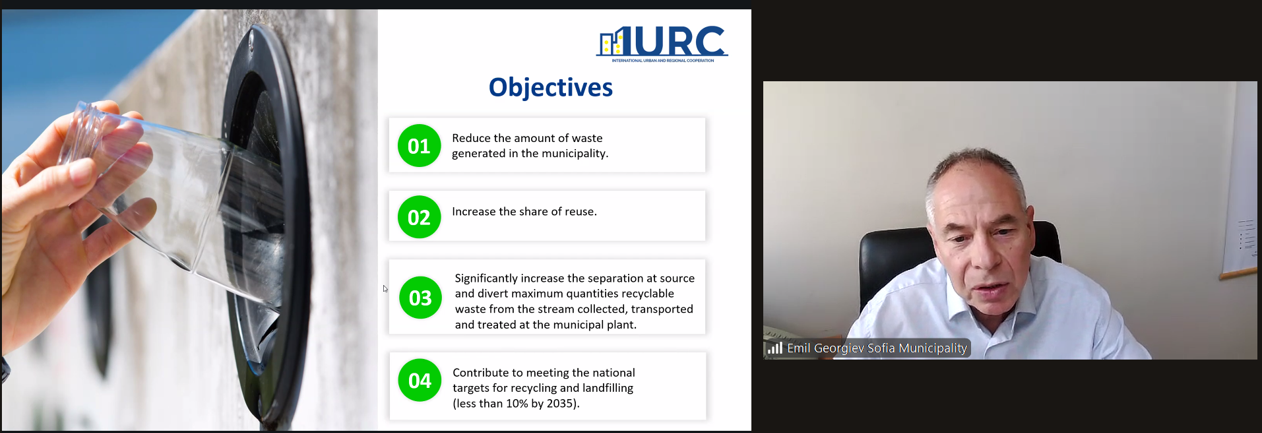
Mr. Emil Georgiev, Director of the Directorate of Planning and Management of Waste Activities in Sofia, Bulgaria, presented the city’s smart waste management strategy, structured around three main objectives: reducing waste generation, increasing reuse, and improving recycling rates . He outlined Sofia’s waste management infrastructure, including treatment facilities and collection systems, as well as public engagement initiatives such as educational campaigns and Pay-As-You-Throw schemes, which mirror approaches also being implemented in Granada.
Key projects discussed included the Khan Bogrov biological waste treatment plant, infrastructure developments related to Extended Producer Responsibility (EPR), and the Kubratovo wastewater treatment plant. Challenges such as illegal dumping were raised during the discussion by representatives from Iskandar Malaysia and Melaka. In response, Mr. Georgiev described the use of CCTV monitoring and enforcement measures to address illegal dumping and improve compliance.
New Taipei’s Green Initiatives and AI-Driven Recycling Automation Initiatives
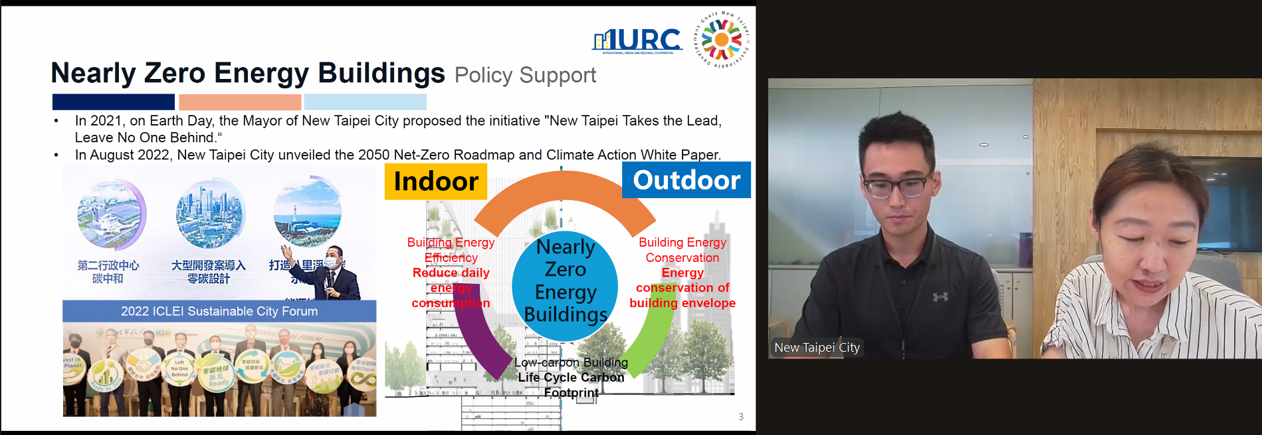
New Taipei City presented its environmental and circular economy initiatives through contributions from Mr. Hung-Yi Liu, Technical Specialist in the Cycle Resources Division of the Environment Protection Department, and Ms. Chun Mu Chang, Assistant Engineer in the Building Permit Division of the Public Works Department .
Ms. Chun Mu Chang outlined policies supporting net-zero energy buildings, energy efficiency, and energy conservation, which have contributed to the city’s growing number of low-carbon buildings. Mr. Hung-Yi Liu focused on recycling and circular economy business solutions, presenting a new recycling facility that uses AI image recognition, automation, and robotic systems to improve sorting efficiency and accuracy while reducing manual labour. The system provides real-time data analytics and supports the city’s goals of reducing contamination, increasing recycling rates, and strengthening technical capacity through international exchanges. New Taipei City also reaffirmed its commitment to advancing sustainable buildings through integrated energy-saving design, construction methods, and materials.
The session concluded with thanks from Ms. Jacqueline Chang, Cluster Manager, who acknowledged the support and facilitation provided by the Cluster Secretariat. She specifically recognised Mr. Ashish Verma, Country Coordinator for India, Ms. Saeko Kadoshima from the Japan Helpdesk, Ms. Ryoko Nakano, Cluster and Pairing Manager for Japan, and Mr. Imura Hidefumi, Senior Expert and Country Coordinator for Japan, for their contributions to the successful delivery of the webinar .