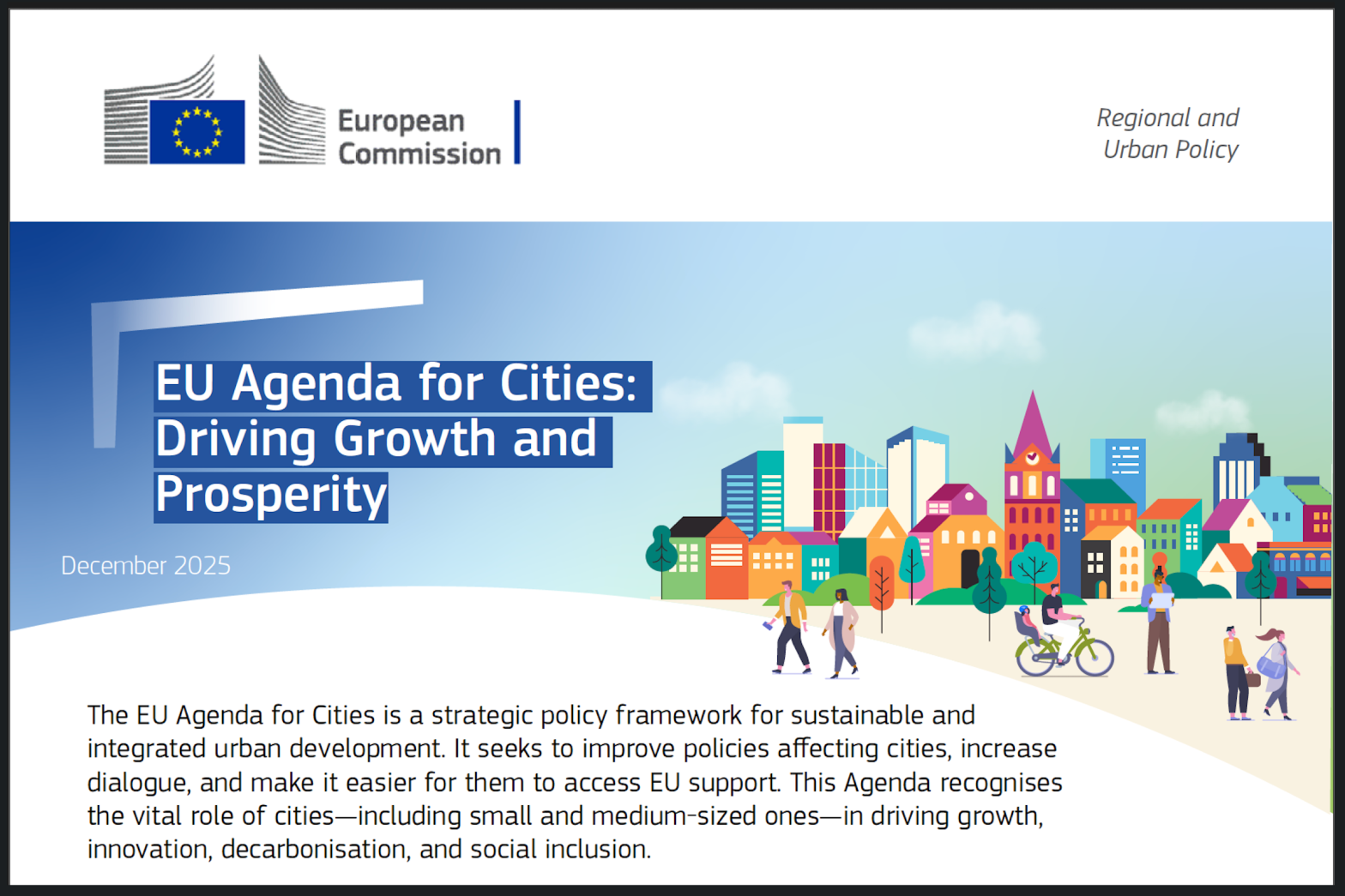
The European Commission has released the Communication “An EU Agenda for Cities: Driving Growth and Prosperity”, presenting a comprehensive framework for sustainable and integrated urban development across Europe. The document outlines how the EU intends to support cities of all sizes in addressing shared challenges and preparing for long-term competitiveness, resilience and social well-being.
In its section on international cooperation, the Communication refers to the International Urban and Regional Cooperation (IURC) programme as one of the EU instruments enabling global collaboration between cities and regions. It notes IURC’s role in connecting EU cities with counterparts in Latin America, Asia, and North America, fostering cooperation on shared challenges such as mobility, energy transition, circular economy and climate adaptation.
This positions IURC within the broader suite of mechanisms through which the EU engages internationally on urban development.
An EU framework for supporting cities
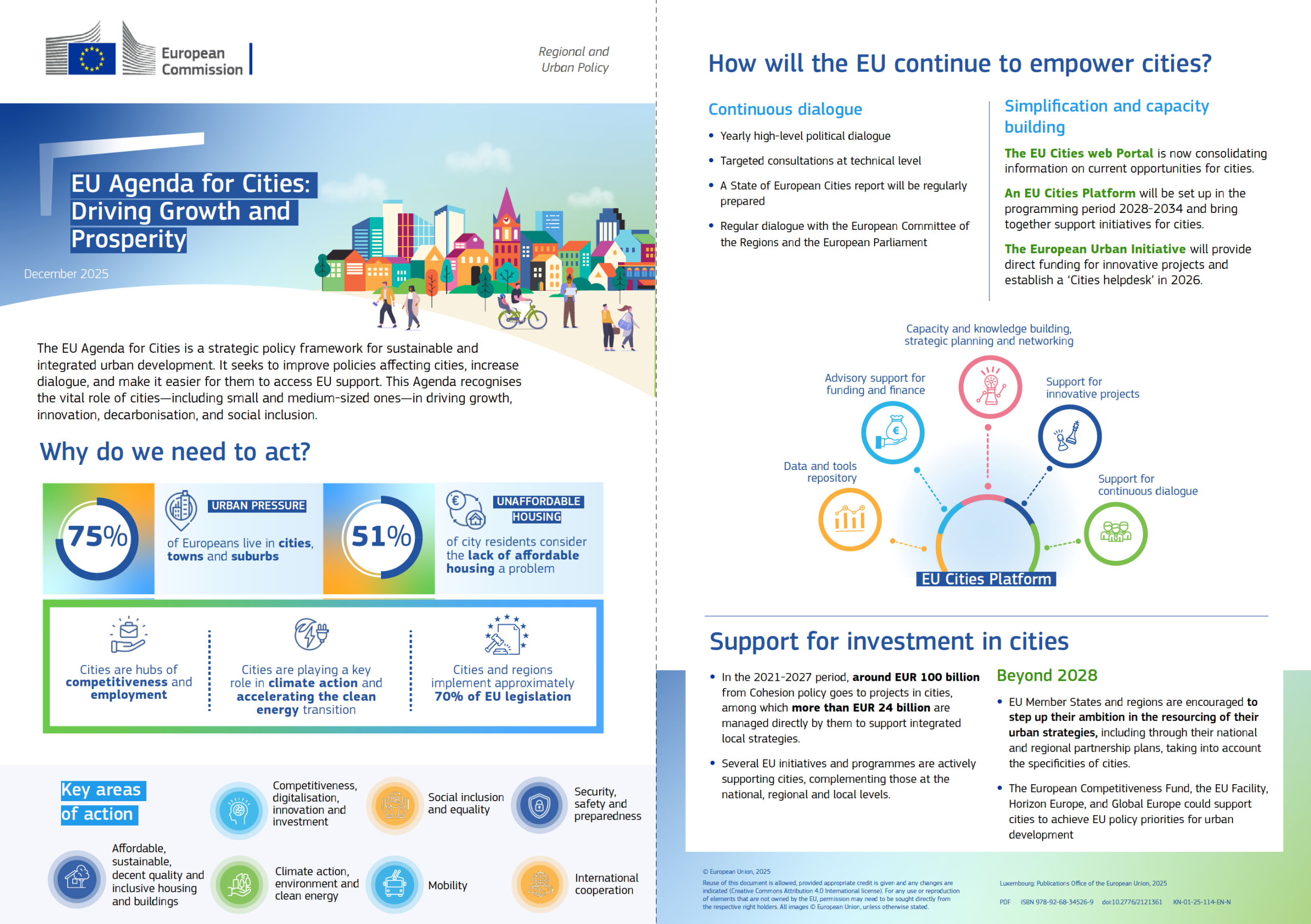
The EU Agenda for Cities responds to the fact that urban areas are home to 75% of the European population and that cities implement a significant share of EU legislation. The Communication sets out measures to help cities manage pressures related to housing, climate change, digitalisation, mobility, competitiveness, social inclusion and preparedness.
Key simplification and capacity building is provided via the following tools:
- the new EU Cities web-portal, providing a consolidated entry point for EU opportunities for cities;
- the forthcoming EU Cities Platform (from 2028), which will bring together EU tools, funding information, technical assistance and knowledge resources into a more coherent structure;
- The European Urban Initiative will provide direct funding for innovative projects and establish a ‘Cities helpdesk’ in 2026.
These steps are designed to simplify access to EU support, improve policy coordination and make it easier for cities—especially smaller and medium-sized ones with limited administrative capacity—to engage with EU instruments.
International cooperation as part of the EU’s urban policy landscape
The Communication emphasises that cities increasingly operate in a global context shaped by economic transitions, climate risks and technological change. It therefore presents international cooperation as one of the seven thematic areas of the EU Agenda for Cities, alongside:
- competitiveness, digitalisation, innovation and investment
- social inclusion and equality
- security, safety and preparedness
- affordable, sustainable and inclusive housing and buildings
- climate action, environment and clean energy
- mobility
- international cooperation
IURC contributes directly to these themes by facilitating exchanges and joint work between EU cities and peers abroad, creating opportunities for comparative learning and co-development of solutions that complement national and EU-level initiatives.
How IURC’s work corresponds to the Agenda’s thematic areas
The thematic areas addressed in the EU Agenda for Cities are also central to the cooperation carried out through IURC partnerships.
Across its city and regional pairings, IURC is active in:
- innovation and digitalisation, improved competitiveness through smart city solutions, urban innovation ecosystems and digital transformation work
- social inclusion and integrated urban development, through approaches to public space, citizen engagement and local regeneration
- security, safety and preparedness, through work on urban resilience, disaster risk reduction and climate adaptation
- sustainable housing and regeneration, where relevant to specific pairings
- climate action, environment and clean energy, including climate-neutrality pathways, biodiversity, circular economy, waste management and renewable energy approaches
- mobility and transport, from public transport planning to active mobility strategies
- and its core mission: international cooperation
By engaging in these areas, IURC supports cities and regions in addressing complex, interconnected challenges in ways that complement the priorities set out in the EU Agenda for Cities.
Positioning IURC within the evolving EU landscape
The Communication presents a renewed structure for how the EU will support its cities going forward. The reference to IURC situates the programme within this wider policy architecture, alongside other EU instruments designed to strengthen urban capacities, support place-based development and encourage global knowledge exchange.
IURC continues to offer participating cities and regions a practical platform for international cooperation, helping them collaborate on shared priorities and draw from global experience as they work toward sustainable, resilient and innovative urban development.
EU Urban Agenda Fact Sheet
European Commission Communication “An EU Agenda for Cities: Driving Growth and Prosperity“
IURC mention is on p.12